Wednesday, April 14, 2010

Project 2 :17th-century Dutch painting (2nd choice)


PIETER DE HOOCH
1658-60
Oil on canvas, 50,8 x 61 cm
I decided to change the artwork because I wasn’t going anywhere with my narrative sentences therefore I picked another17th century Dutch painting.

Spatial Narrative

A secretative hideway for a woman who prides boldness and enjoys a fixed routine
OR
A relaxing getaway for a powerful man where he like to be pampered.

Project 2 :17th-century Society

Society and economy in the Dutch republic

o The state tolerated many different religions.
o The Dutch had large merchant and shipping fleets. In 1670, about ten per cent of Dutch adult males were sailors; - the Dutch had more ships than England, France, Germany, Portugal, Scotland, and Spain combined.

• Dutch fishermen caught vast quantities of herring, particularly in the North Sea fishing grounds. On purpose-built ships called buizen ("busses") the fish were gutted, salted and barreled. Other faster ships - ventjagers ("sale-hunters") - sailed out to meet the buizen, so that the catch could be transferred and delivered to market quickly while the large, slow buizen returned to the fishing ground to catch still more fish.


o Dutch vessels were very important in the carrying trade. Western Europe's major source of timber was the wooded southern shore of the Baltic - the most important port being Danzig. Dutch vessels moved almost all the timber in the seventeenth century, but the English were also concerned in the trade. Both the Dutch and the English depended on Baltic timber for shipbuilding, and the wars and diplomacy with Sweden and Denmark revolved around these countries' need to guarantee freedom of timber supplies through the Baltic Sound.
o The Dutch exploited the the wind-powered saw-mill (invented 1596) to turn timber into lumber more efficiently than their rivals.
o The Dutch built ships more cheaply, more quickly and better than did any of their rivals.


o Dutch ships also carried exports of cloth manufactured in the Netherlands (Leiden and Amsterdam were the largest centers).


• Dutch religious tolerance attracted skilled workers, many of whom came to work in the new draperies - light cloths that increasingly replaced expensive high-quality woolen cloth.

o Dutch agricultural output had increased in part because of land reclamation. During the first half of the seventeenth century, the Dutch drained large areas of land.


o Another necessity that the Dutch turned into a virtue was the shortage of land. In other Western European countries the wealthy bought large estates, but unable to do this, the Dutch invested in trade, insurance, and banking.


o There was some poverty in the Netherlands despite its overall prosperity, but the Netherlands did have a system of civic poor relief and charitable institutions that was the envy of Europe. The old, the insane, the sick, disabled, and orphans were all supported and put to useful work wherever possible. The system was - of course - also one of social control and its dependents were given religious instruction and subjected to discipline. Nevertheless, perhaps as many of ten per cent of the larger cities' inhabitants benefited directly from the system.


o To maintain local order, Dutch towns raised civic militias from the ranks of the modestly wealthy (shopkeepers, lumber dealers). Militia officers were often closely related to local government officials. The Civic militias were not usually of any political importance, but in 1672 their decision to side with the populace and against those members of the elite willing to capitulate to France, was crucial.

Project 2 :17th-century Artist

Research about the artist :

• Dutch painter.
• He was a generalist artist, doing portraits, history paintings, marine scenes and, chiefly, the interiors of churches.These are usually quite imaginary churches, exercises in mood as much as architecture, complex overlays of arches and pillars and organ pipes, darkened with atmospheric gulfs of shadow.
• He also did markets, with hearty traders and slimy fish.
• He was often in debt, and his longish life appears to have been ended by suicide

• He had a long career as an unpromising figure painter,
• Later de Witte’s interpreted architectural interiors predominantly in terms of light and shade, and—in their casual drawing, comparatively broad brushwork and uncertain articulation of space.
• From the beginning, de Witte’s imagination seemed to have responded more to the great spaces than to the forms of Dutch Gothic churches, to the evocative contrasts of sunlight and shadow and to the people who visited and worshipped in these communal and spiritual environments.
• The Oude Kerk in Delft with Pulpit (1651; London, Wallace), de Witte’s first dated church interior, suggests in its descending daylight some communication between the heavens and the quiet congregation; the preacher in the pulpit, unlike van Vliet’s gravediggers and some of Houckgeest’s tourists, plays a comparatively inconspicuous part.
• in de Witte’s approach, archways and windows were as assertively shapes in the compositional pattern as a solid architectural element or a piece of furniture.
• de Witte de-emphasized diagonal and direct recessions into depth in favour of forms spaced at rhythmic intervals from side to side. Zones of space are thus layered and interrelated by a continuous interplay of solid and void, as well as by rich harmonies of light and shade.
• De Witte also used linear perspective
• de Witte passed from ‘portraits’ of actual churches to paintings of imaginary buildings, many of which incorporate elements of Amsterdam’s main churches and Stadhuis
• de Witte also worked rather like a landscape painter, employing plausible and sometimes actual elements to create largely invented views.
• Later de Witte painted outdoor market scenes,
• The quality of de Witte’s work varied considerably, due partly to his unstable temperament, But most of his surviving works are exceptionally good
Bibliography
A. Houbraken: De groote schouburgh (1718–21), i, pp. 223, 282–7; ii, p. 292
I. Manke: Emanuel de Witte, 1617–1692 (Amsterdam, 1963)
W. A. Liedtke: Architectural Painting in Delft: Gerard Houckgeest, Hendrick van Vliet, Emanuel de Witte (Doornspijk, 1982)

Project 2 :17th-century Context of Artist

Context : Art in the Northern Netherlands, 1585–1700
• Within a few decades after Antwerp fell to the armies of Philip II in 1585, its population was reduced by half, to around fifty thousand. Because the northern Netherlands now controlled the entrance to the Scheldt River on which Antwerp lay, the city lost to Amsterdam its position as the leading port in northern Europe.
• Artists fled to the northern Netherlands as Protestants and sought relief from the repressive policies of the Catholic Habsburg rulers
• They responded to the tastes of a predominantly Protestant culture (and the growing wealth of a broad middle class that was concentrated in the cities.
• The earliest examples of a uniquely northern Netherlandish art were in the 1580s.
• the first works these artists produced were dramatically mannerist
• The new Protestant faith had little use for religious imagery. Nevertheless, religious paintings continued to be produced (although on a much smaller scale) for hidden Catholic churches to which municipal authorities turned a blind eye, for private devotion in the home, and even for Protestant collectors.
• the Dutch were better known for secular subjects and contemporary scenes, they also produced important history paintings. Pastoral subjects, from classical mythology and contemporary plays, were popular with members of the stadtholder's court. Later, a taste for such works was developed by wealthy burghers who increasingly aspired to an aristocratic lifestyle.
• While history painting traditionally enjoyed the highest prestige, there was a tremendous demand for portraiture as well in a culture where men and women were amassing fortunes and defining new social roles.
• There was also a demand of genre painting—depictions of men and women in contemporary interiors, from a broad range of social classes, and engaged in mundane tasks—has always been closely associated with seventeenth-century Dutch art.
• In observing the world around them, Dutch painters developed a unique genre, the church interior painting. This appeared to record the church exactly, manipulate both the perspective and details of the interior.

Project 2 :17th-century Dutch painting


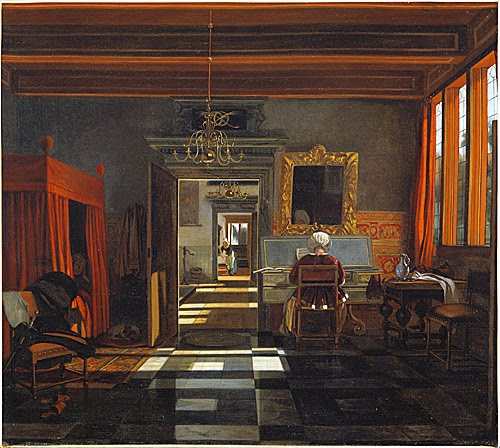
Emmanuel de Witte
1617-1692
Interior with a Woman Playing a Virginal
About 1660
Oil on canvas